Putting Wealth to Work by Joel L. Fleishman
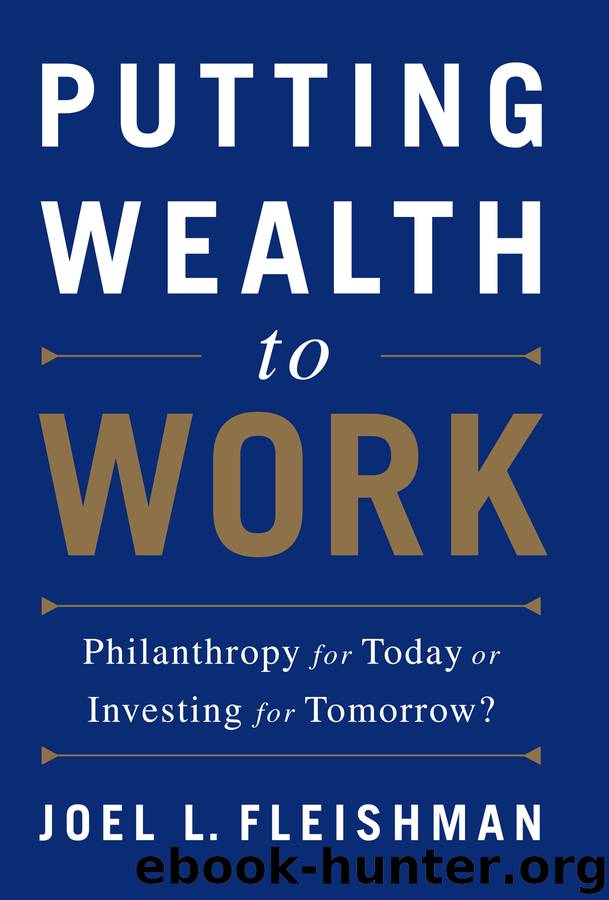
Author:Joel L. Fleishman
Language: eng
Format: epub
Publisher: PublicAffairs
Published: 2017-09-26T04:00:00+00:00
FEAR OF TIMIDITY
It is conventional wisdom that, in principle even if not a widespread practice, one of the cardinal obligations of both perpetual and life-limited foundations is to pioneer solutions to public problems that government itself would be loath to undertake because of their inherent risks. Indeed, that assumption is one of the primary rationales offered by wealthy individuals, foundations, and observers of philanthropy for giving-while-living and spend-down foundations. The hope is that an intense, short-term burst of philanthropy in some field of need would lead to pioneering experiments that reveal what works and what doesn’t work, thereby reducing the risk to government in implementing a solution to the problem being focused upon.
In the case of limited-life foundations in which the donor/founder is still active, his or her gutsiness might well set a low bar (or a large appetite) for risk, and the donor/founder will then be around to enjoy the applause if the experiment works out well and can take the heat if it doesn’t. But after the donor/founder has left the scene, which is eventually the case with perpetual foundations, choosing a high-risk course of action becomes more difficult, as there may then be no obvious trustee around at crunch time who is sturdy enough to take the fall.
That suggests that when the donor of a perpetual foundation dies, whatever possibility there might have been for high-risk grantmaking will likely be diminished. That point has been eloquently made by Bernie Marcus of The Home Depot and The Marcus Foundation: “As a living donor/chairman of a foundation, I can and do take significant risks in my philanthropy. After I die, my foundation will likely be unable to emulate my risk-taking approach to philanthropy because boards of trustees without living donors usually don’t have anyone with the same degree of moral and legal authority necessary to take big risks.”17
It is impossible to disagree in principle with Marcus’s point. Clearly, a foundation with living donors, if they are truly inclined to make big bets on high-risk grants, has a much freer hand to take on significant risk. But it is not a foreordained conclusion that successor trustees will not follow in the donor’s footsteps. If the successor trustees are carefully chosen, as were those of Andrew Carnegie, Alfred P. Sloan, and Robert Wood Johnson, and if the founder has blazed a trail for high-risk grantmaking that can set an example for those who come after, the tolerance for high-risk grants need not diminish. Long after Carnegie died, his successor trustees made the decision to try to create a Public Broadcasting System and a National Public Radio for the United States. Decades after the death of General Johnson, the Robert Wood Johnson trustees decided to establish a grantmaking program to diminish teenage pregnancies, to discourage teenage smoking, and to develop strategies for diminishing obesity—all of which are about as high risk as any foundation’s efforts anywhere. And 50 years after the death of Alfred P. Sloan, his successor trustees decided to seed
Download
This site does not store any files on its server. We only index and link to content provided by other sites. Please contact the content providers to delete copyright contents if any and email us, we'll remove relevant links or contents immediately.
| Anthropology | Archaeology |
| Philosophy | Politics & Government |
| Social Sciences | Sociology |
| Women's Studies |
The Great Music City by Andrea Baker(34077)
Cecilia; Or, Memoirs of an Heiress — Volume 1 by Fanny Burney(32753)
Cecilia; Or, Memoirs of an Heiress — Volume 2 by Fanny Burney(32115)
Cecilia; Or, Memoirs of an Heiress — Volume 3 by Fanny Burney(32097)
We're Going to Need More Wine by Gabrielle Union(19244)
All the Missing Girls by Megan Miranda(16844)
For the Love of Europe by Rick Steves(15004)
Pimp by Iceberg Slim(14825)
Bombshells: Glamour Girls of a Lifetime by Sullivan Steve(14245)
Norse Mythology by Gaiman Neil(13691)
Talking to Strangers by Malcolm Gladwell(13580)
Fifty Shades Freed by E L James(13376)
Mindhunter: Inside the FBI's Elite Serial Crime Unit by John E. Douglas & Mark Olshaker(9559)
Crazy Rich Asians by Kevin Kwan(9443)
The Lost Art of Listening by Michael P. Nichols(7639)
Enlightenment Now: The Case for Reason, Science, Humanism, and Progress by Steven Pinker(7453)
The Four Agreements by Don Miguel Ruiz(6949)
Bad Blood by John Carreyrou(6758)
Weapons of Math Destruction by Cathy O'Neil(6499)
